
Moz vs. Ahrefs: Which SEO Tool is Better for You?

Choosing between Moz and Ahrefs, two titans in the SEO software industry, is not about identifying a universally "better" tool, but rather determining which platform aligns more precisely with your specific SEO goals, budget, and operational workflow. Ahrefs generally holds an edge in backlink data depth and freshness, making it a preferred choice for aggressive link building and comprehensive competitor analysis, while Moz often appeals to users prioritizing domain authority metrics, local SEO, and a more guided, user-friendly experience, particularly for those newer to advanced SEO. This comprehensive comparison will dissect their core functionalities, data quality, user experience, and pricing to help you make an informed decision for your content strategy.
Key Takeaways
- Ahrefs excels in backlink data, offering a larger and fresher index, making it ideal for in-depth link analysis and competitive backlink strategy.
- Moz provides a robust suite of tools with a strong emphasis on Domain Authority (DA) and Page Authority (PA), alongside comprehensive local SEO features.
- Keyword research capabilities are strong in both platforms, though Ahrefs often provides more granular data on SERP features and content gaps, while Moz focuses on keyword prioritization.
- Site audits are comprehensive in both, identifying critical technical SEO issues, but Ahrefs may offer more actionable insights for larger, more complex websites.
- Pricing structures differ significantly; Ahrefs typically offers more features at its entry-level, while Moz's Pro plans scale with more advanced needs, making budget a crucial consideration.
- For content marketers, Ahrefs' Content Explorer is a powerful tool for topic discovery and competitive content analysis, a feature less directly comparable in Moz.
Understanding Moz and Ahrefs: Core Philosophies and Data Acquisition
Moz and Ahrefs are both industry-leading SEO software suites, each approaching the complex task of search engine optimization with distinct foundational philosophies and data collection methodologies. Moz, established earlier, built its reputation on metrics like Domain Authority (DA) and a strong community focus, while Ahrefs rapidly grew by boasting one of the largest and freshest backlink indexes in the SEO world. These underlying approaches dictate their strengths and how they ultimately serve different user needs within the vast landscape of digital marketing.Moz's Approach: Authority, Community, and Education
Moz positions itself as an all-in-one SEO solution, emphasizing website authority and providing educational resources alongside its tools. Its core metrics, Domain Authority (DA) and Page Authority (PA), are proprietary scores predicting a website's ranking ability based on various factors, primarily link metrics. Moz's data acquisition includes crawling the web, analyzing link profiles, and processing vast amounts of keyword data, but it also heavily leverages its community and thought leadership to inform its product development and user experience.Ahrefs' Approach: Backlinks, Data Depth, and Competitive Intelligence
Ahrefs focuses intensely on providing the most comprehensive and up-to-date backlink data available, which it considers the cornerstone of robust SEO analysis. Its proprietary Ahrefs Rank (AR) and Domain Rating (DR) are key metrics, often cited as more granular and frequently updated than comparable metrics. Ahrefs employs an extensive network of crawlers, similar to search engines, to discover and index billions of web pages daily, resulting in an exceptionally fresh and expansive database of backlinks, keywords, and content. This aggressive data acquisition strategy fuels its powerful competitive analysis features, allowing users to dissect competitor strategies with precision.Key Differences in Data Philosophy
The primary distinction lies in their data priorities. Moz prioritizes a holistic view of website authority and usability, integrating various SEO aspects into its tools and metrics. In contrast, Ahrefs places an unparalleled emphasis on the sheer volume, freshness, and granularity of backlink and keyword data, making it particularly potent for deep dives into competitive landscapes and aggressive growth strategies. This difference manifests in the specific features and insights each tool offers across all SEO disciplines.Keyword Research: Unearthing Opportunities
Effective keyword research is the bedrock of any successful SEO strategy, and both Moz and Ahrefs provide powerful tools to identify valuable search terms, analyze their potential, and understand the competitive landscape. While both platforms offer comprehensive insights into search volume, keyword difficulty, and SERP features, their interfaces, proprietary metrics, and the depth of specific features can significantly influence a user's workflow and discovery process. Understanding these nuances is crucial for content creators aiming to rank high.Moz Keyword Explorer: Prioritization and Topical Relevance
Moz's Keyword Explorer is designed to help users not just find keywords but also prioritize them based on a unique blend of metrics. It provides estimated monthly search volume, a proprietary "Difficulty" score (predicting how hard it is to rank), and an "Organic CTR" score, which estimates the click-through rate given the current SERP features. Furthermore, its "Priority" score combines these factors to give a single, actionable metric for keyword selection.Key Features of Moz Keyword Explorer:
- Keyword Suggestions: Generates a wide array of related keyword ideas, including broad matches, questions, and "also rank for" suggestions.
- SERP Analysis: Provides a detailed breakdown of the top 10 ranking pages for a keyword, including their Domain Authority, Page Authority, and linking root domains.
- Lists: Allows users to save and organize keywords into lists for ongoing monitoring and analysis.
- Difficulty Score: A proprietary metric indicating the ranking challenge, based on the Moz link profile strength of competing pages.
- Organic CTR: Estimates the actual click potential, accounting for ads and SERP features that might reduce organic clicks.
Ahrefs Keywords Explorer: Data Depth and Competitive Insights
Ahrefs Keywords Explorer is renowned for its vast database of keywords and the depth of its competitive analysis, making it an indispensable tool for uncovering content gaps and aggressive keyword targeting. It offers extremely granular data on search volume, a proprietary "Keyword Difficulty" (KD) score (based primarily on the number of referring domains to the top-ranking pages), and detailed SERP overviews that include traffic estimations for each ranking page. Ahrefs also excels in showing parent topics and comprehensive "also rank for" keywords, which helps in identifying clusters and broader content strategies.Key Features of Ahrefs Keywords Explorer:
- Keyword Ideas: Generates millions of keyword suggestions based on various match types (phrase match, having same terms, questions, newly discovered).
- Keyword Difficulty (KD): A score from 0-100 indicating how hard it is to rank in the top 10 for a keyword, based on the backlinks to current top-ranking pages.
- SERP Overview: Displays the top 100 search results, including estimated traffic, number of backlinks, referring domains, and Domain Rating for each page.
- Parent Topic: Helps identify the main topic a keyword belongs to, facilitating content clustering and topic authority building.
- Traffic Share by Domain: Shows which websites capture the most traffic for a given set of keywords, offering competitive intelligence.
- Content Gap Analysis: Identifies keywords your competitors rank for but you don't, a powerful feature for expanding your content strategy.
Comparison of Keyword Research Capabilities
While both tools are excellent, Ahrefs often provides a larger volume of keyword suggestions and more detailed competitive SERP analysis, including estimated traffic for individual ranking pages. Its Keyword Difficulty metric is directly tied to backlinks, offering a clear path for link-building efforts. Moz's Keyword Explorer, with its "Priority" score and Organic CTR metric, provides a more curated and actionable pathway for users who want to quickly identify high-impact keywords without getting lost in excessive data. For content creators using AI tools, leveraging keyword data from either platform is crucial. For instance, understanding keyword difficulty and search intent from these tools can directly inform the prompts for an AI content generator, ensuring the output is optimized from the start. You can then use tools like UPAI's Keyword Density checker to ensure your AI-generated content effectively incorporates target terms.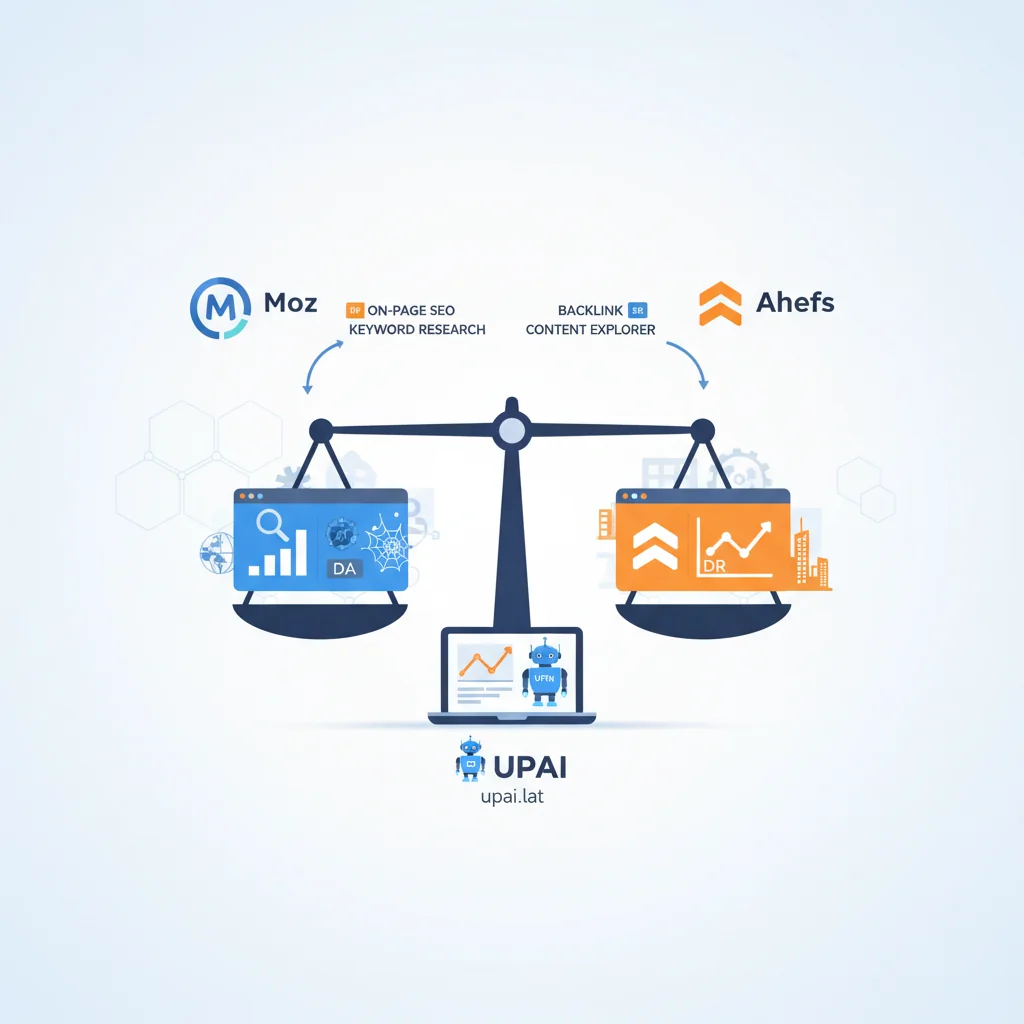
Backlink Analysis: The Foundation of Off-Page SEO
Backlink analysis is arguably the most critical component of off-page SEO, directly influencing a website's authority and search engine rankings. Both Moz and Ahrefs offer sophisticated tools to analyze backlink profiles, identify linking opportunities, and uncover toxic links, yet they differ significantly in the size and freshness of their backlink indexes, their proprietary metrics, and the depth of their investigative features. Ahrefs is widely recognized for its unparalleled backlink data, while Moz provides a robust, albeit sometimes less extensive, view with valuable proprietary authority scores.Moz Link Explorer: Authority and Spam Score
Moz's Link Explorer provides a comprehensive overview of a website's backlink profile, focusing on its proprietary Domain Authority (DA) and Page Authority (PA) metrics. These scores, ranging from 1 to 100, predict a website's or page's ranking strength based on its link equity. Moz also offers a "Spam Score" to help users identify potentially harmful or low-quality links that could negatively impact rankings. While its index might be smaller than Ahrefs', Moz's emphasis on authority metrics and spam identification is highly valuable for understanding link quality.Key Features of Moz Link Explorer:
- Domain Authority (DA) and Page Authority (PA): Predictive ranking metrics for websites and individual pages.
- Spam Score: Identifies potential toxic links based on a scale of 0-17, helping with disavow strategies.
- Linking Domains: Shows the number of unique websites linking to your site or a specific page.
- Anchor Text Distribution: Analyzes the anchor text used in incoming links, providing insights into topical relevance and potential over-optimization.
- Top Pages by Links: Identifies which pages on a site attract the most backlinks, highlighting valuable content.
- Link Intersect: Helps find sites that link to your competitors but not to you, identifying potential link-building opportunities.
Ahrefs Site Explorer (Backlinks): Deep Dive into Link Data
Ahrefs' Site Explorer is the gold standard for backlink analysis, boasting the largest and freshest backlink index among all SEO tools. It provides an exhaustive list of backlinks, referring domains, and proprietary metrics like Domain Rating (DR) and URL Rating (UR), which are often updated more frequently than Moz's DA/PA. Ahrefs' strength lies in its ability to show every single backlink, its context, and its historical data, enabling incredibly detailed competitive analysis and link-building strategy.Key Features of Ahrefs Site Explorer (Backlinks):
- Domain Rating (DR) and URL Rating (UR): Proprietary metrics indicating the strength of a website's or page's backlink profile.
- Referring Domains: Shows the total number of unique domains linking to the target, and how many are new or lost.
- Backlinks Report: Provides a comprehensive list of all backlinks, including anchor text, target URL, referring page, and link type (dofollow/nofollow).
- New & Lost Backlinks: Tracks changes in backlink profile over time, essential for monitoring link-building efforts and identifying issues.
- Broken Backlinks: Identifies broken links on your site or competitor sites, which can be opportunities for link reclamation or outreach.
- Link Intersect: A powerful feature to find websites that link to multiple competitors but not to your site, providing highly relevant prospects for outreach.
- Organic Traffic Value of Backlinks: Estimates the value of traffic driven by specific backlinks.
Comparison of Backlink Analysis Tools
Ahrefs generally offers a more extensive and frequently updated backlink index, making it superior for aggressive link-building campaigns, detailed competitor backlink analysis, and identifying specific link opportunities. Its sheer volume of data and granular filtering options allow for deep dives into any site's link profile. Moz's Link Explorer, while having a smaller index, provides highly valuable context through its Domain Authority, Page Authority, and Spam Score, which are crucial for assessing link quality and prioritizing disavow efforts. For content marketers creating content, understanding the backlink profiles of top-ranking competitors (from either tool) is vital. This knowledge can inform content strategy, helping to identify what kind of content attracts links and how to structure outreach efforts.Site Audits and Technical SEO: Ensuring a Healthy Website
Technical SEO is the foundation upon which all other SEO efforts are built, ensuring that search engines can effectively crawl, index, and understand your website. Both Moz and Ahrefs offer robust site audit tools designed to identify critical technical issues that could hinder performance, including broken links, crawl errors, duplicate content, and indexing problems. While both provide comprehensive reports, their diagnostic methodologies, reporting granularity, and actionable recommendations can vary, catering to different levels of technical expertise and website complexity.Moz Site Crawl: Comprehensive Issue Identification
Moz's Site Crawl tool performs a thorough technical audit of your website, identifying a wide range of issues that impact SEO. It categorizes errors by severity and provides clear explanations and recommendations for fixing them. Moz's audit focuses on crawlability, on-page elements, duplicate content, and overall site health, making it an excellent tool for identifying foundational problems and monitoring progress over time.Key Features of Moz Site Crawl:
- Crawlability Issues: Detects problems like blocked pages, broken redirects, and server errors that prevent search engines from accessing content.
- On-Page Issues: Identifies missing or duplicate title tags, meta descriptions, and heading tags, which are crucial for content optimization.
- Duplicate Content: Pinpoints pages with identical or near-identical content, which can dilute ranking power.
- Performance Issues: Flags slow-loading pages and large file sizes that impact user experience and SEO.
- Missing Alt Text: Helps identify images without descriptive alt text, improving accessibility and image SEO.
- Custom Crawls: Allows users to configure specific crawl settings for deeper analysis of particular sections of a website.
Ahrefs Site Audit: In-Depth Technical Analysis and Actionable Insights
Ahrefs Site Audit is renowned for its depth, speed, and comprehensive reporting, providing an unparalleled view of a website's technical health. It crawls a site much like a search engine, identifying over 140 pre-defined SEO issues across nine categories, including performance, HTML tags, social tags, and localization. Ahrefs excels in providing highly actionable recommendations, often with direct links to the problematic pages and detailed explanations, making it a favorite for SEO professionals managing complex sites.Key Features of Ahrefs Site Audit:
- Comprehensive Issue Categories: Checks for over 140 common SEO issues across categories like performance, HTML tags, content quality, social tags, and localization.
- Health Score: Provides an overall score for your website's technical health, making it easy to track improvements.
- Internal Link Analysis: Visualizes internal link structure, identifies orphaned pages, and helps optimize link equity distribution.
- Duplicate Content Checker: Detects duplicate titles, meta descriptions, and content, and suggests canonicalization strategies.
- Page Speed Insights: Integrates data to highlight pages with slow loading times and offers specific recommendations for improvement.
- Structured Data Validation: Checks for errors in schema markup, ensuring rich snippets are properly implemented.
- Customizable Crawls: Allows for highly granular control over crawl settings, including crawl speed, user agents, and URL exclusions.
Comparison of Site Auditing Tools
Both Moz and Ahrefs offer robust site auditing capabilities essential for maintaining a healthy website. Ahrefs Site Audit generally provides a more granular and extensive report, identifying a wider array of technical issues with highly actionable recommendations, often preferred by technical SEO specialists and larger organizations. Its internal linking visualization and structured data validation are particularly strong. Moz's Site Crawl offers a user-friendly interface with clear explanations, making it highly accessible for general marketers and small business owners who need to quickly identify and address common SEO problems. For any content creator, ensuring the technical health of their site is paramount. After generating content with AI, a site audit can confirm that the page is crawlable and indexable. You can also use UPAI's SEO Checker to get an instant analysis of individual page SEO health, complementing the broader site audit.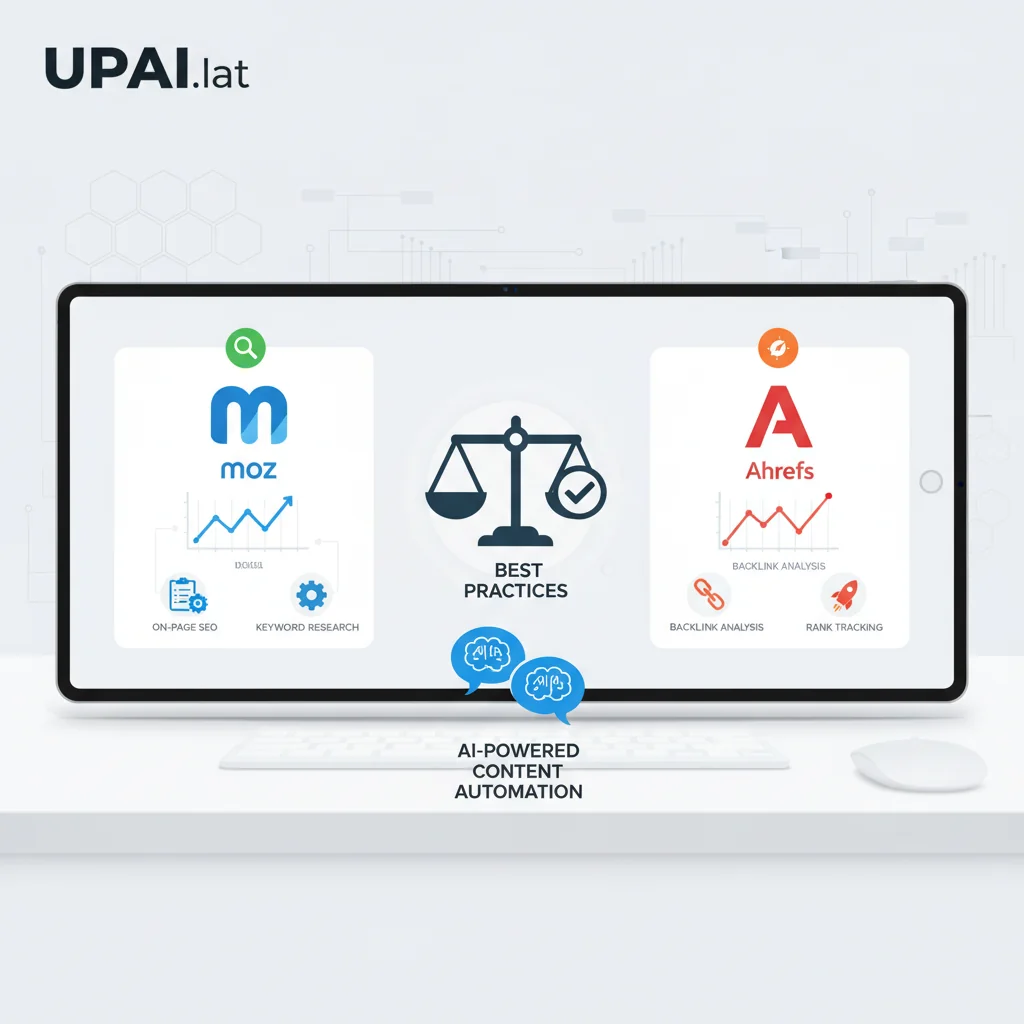
Content Marketing and On-Page SEO: Crafting High-Ranking Content
Content marketing and on-page SEO are inextricably linked, as high-quality, optimized content is the primary driver of organic traffic and user engagement. Both Moz and Ahrefs provide tools and features that assist content marketers in identifying relevant topics, understanding audience intent, and optimizing their content for search engines. While Ahrefs offers a dedicated "Content Explorer" for competitive content analysis, Moz's approach integrates content insights across its keyword research and site audit tools, emphasizing a holistic content strategy.Moz's Approach to Content Optimization
Moz doesn't have a single, dedicated "content explorer" tool like Ahrefs, but its features across Keyword Explorer and On-Page Grader (part of Site Crawl) significantly aid content creation and optimization. By providing detailed keyword metrics, competitive SERP analysis, and on-page recommendations, Moz helps users craft content that is both relevant and technically sound. Its focus on Domain Authority also guides content creators towards topics and formats that are likely to attract authoritative backlinks.Key Moz Features for Content:
- Keyword Explorer: Helps identify high-volume, low-difficulty keywords and related topics, informing content ideas.
- On-Page Grader: Provides specific recommendations for optimizing title tags, meta descriptions, headings, and content length for target keywords.
- SERP Analysis: Allows content creators to study the top-ranking content for a given keyword, understanding what performs well.
- Link Explorer: Can be used to identify content on competitor sites that attracts a high number of backlinks, inspiring link-worthy content ideas.
Ahrefs Content Explorer: Discovering High-Performing Content
Ahrefs Content Explorer is a powerful standalone tool designed specifically for content marketers to find popular content, analyze its performance, and discover content gaps. It allows users to search for content across a massive index of web pages, filtered by various metrics like organic traffic, referring domains, social shares, and publication date. This makes it exceptionally useful for topic ideation, competitive analysis, and identifying successful content strategies.Key Features of Ahrefs Content Explorer:
- Content Discovery: Find millions of articles, blog posts, and other content types related to any topic or keyword.
- Performance Metrics: Filter results by organic traffic, referring domains, social shares, and estimated traffic value.
- Broken Pages: Discover broken pages on competitor sites that previously had many backlinks, offering opportunities for link reclamation.
- Content Gap Analysis: Identify topics where competitors have high-performing content but you don't.
- Author Analysis: Find influential authors in your niche.
- Historical Data: See how content performance has changed over time.
- Content Analyzer: Provides on-page insights for a specific URL, including word count, readability, and keyword usage.
Comparison of Content Marketing and On-Page SEO Tools
For content marketers, Ahrefs' Content Explorer offers a more direct and powerful solution for content ideation, competitive content analysis, and identifying what content performs best in a given niche. Its ability to filter by organic traffic and referring domains provides clear indicators of content success. Moz's tools, while not having a dedicated "content explorer," still provide valuable insights for crafting optimized content through its keyword research and on-page grading features. For those using AI to generate content, the insights from both tools are invaluable. For example, using Ahrefs Content Explorer to find high-performing articles can inform the structure and depth of AI-generated content. After AI generates the draft, tools like UPAI's Readability checker and Headline Analyzer can refine the content further, ensuring it's engaging and optimized. You can also generate FAQ Schema based on common questions found in competitor content, boosting your page's visibility in SERP features.Rank Tracking: Monitoring Performance
Rank tracking is an essential SEO activity that allows businesses and marketers to monitor their website's visibility in search engine results for target keywords. Both Moz and Ahrefs provide sophisticated rank tracking capabilities, enabling users to observe keyword positions, analyze competitor performance, and understand the impact of their SEO strategies over time. While the core functionality of tracking keyword positions is similar, differences emerge in update frequency, geographical granularity, and the depth of competitive insights.Moz Rank Tracker: Local and Global Monitoring
Moz's Rank Tracker is integrated within its Campaign feature, allowing users to monitor keyword rankings for their website and competitors across various search engines (Google, Google Mobile, Bing) and geographical locations. It provides daily or weekly updates, tracks both organic and local pack rankings, and visualizes progress over time with clear graphs and reports. Moz emphasizes local SEO in its tracking, which is particularly beneficial for businesses with a physical presence.Key Features of Moz Rank Tracker:
- Daily/Weekly Updates: Provides consistent data on keyword performance.
- Local Rank Tracking: Specific tracking for local pack results, crucial for local businesses.
- Competitor Tracking: Monitor up to four competitors' rankings for your target keywords.
- SERP Feature Tracking: Identifies if your content appears in featured snippets, local packs, or other SERP features.
- Visibility Score: A proprietary metric indicating your overall visibility across tracked keywords.
- Reporting: Customizable reports to share ranking progress with stakeholders.
Ahrefs Rank Tracker: Comprehensive and Granular Insights
Ahrefs Rank Tracker offers a highly granular and comprehensive view of keyword performance, tracking rankings across numerous countries and languages, including mobile and desktop results. It provides daily updates and offers extensive competitive analysis, showing not only your rankings but also how they compare to a specified list of competitors. Ahrefs excels in visualizing ranking fluctuations, estimating traffic from tracked keywords, and identifying opportunities to improve positions.Key Features of Ahrefs Rank Tracker:
- Daily Updates: Ensures the most current data on keyword positions.
- Global & Local Tracking: Supports tracking across 170+ countries and various languages, with city-level tracking available.
- Competitor Monitoring: Track an unlimited number of competitors for your keywords, comparing performance side-by-side.
- SERP Features: Monitors which SERP features your website ranks for, such as featured snippets, top stories, and image packs.
- Estimated Traffic: Provides an estimate of the organic traffic driven by your tracked keywords.
- Visibility & Average Position: Tracks overall visibility and average ranking position for your keyword set.
- Tags & Filtering: Allows for detailed organization and analysis of keywords by applying custom tags.
Comparison of Rank Tracking Capabilities
Ahrefs Rank Tracker generally offers more extensive and granular data, particularly concerning the number of countries and languages supported, and the depth of competitive insights. Its estimated traffic from tracked keywords is a powerful metric for understanding the business impact of ranking changes. Moz's Rank Tracker is highly effective, especially for businesses with a strong local SEO focus, and its Visibility Score provides a quick overview of overall performance. Both are robust tools, but Ahrefs often provides more data for those managing large-scale international SEO campaigns or requiring very precise competitive comparisons. Regularly checking your rankings with either tool is vital for refining your content strategy and ensuring your AI-generated content is hitting its mark. You can then use UPAI's SERP Preview tool to visualize how your optimized titles and meta descriptions appear in search results, helping to improve click-through rates.User Interface and Experience: Navigating the Platforms
The user interface (UI) and user experience (UX) of an SEO tool significantly impact how efficiently and effectively users can leverage its powerful features. A well-designed platform can streamline complex tasks, reduce the learning curve, and make data interpretation more intuitive. Both Moz and Ahrefs have evolved their UIs over time, each developing a distinct approach to presenting vast amounts of SEO data, catering to different user preferences and levels of expertise.Moz's UI/UX: Guided and Intuitive
Moz is often praised for its clean, intuitive interface, making it particularly accessible for SEO beginners and general marketers who may not have extensive technical SEO backgrounds. Its dashboards are well-organized, and the navigation is straightforward, typically guiding users through workflows with clear labels and tooltips. Moz places a strong emphasis on education, with many features accompanied by explanations and links to their extensive learning resources.Key Aspects of Moz's UI/UX:
- Clean Dashboards: Provides an at-a-glance overview of key metrics and site health.
- Guided Workflows: Tools are often designed to lead users through a logical sequence of steps.
- Educational Support: Extensive help articles, tutorials, and the Moz Academy are readily accessible.
- Visualizations: Uses clear graphs and charts to represent data trends and comparisons.
- Campaign-Centric Design: Organizes data around specific website campaigns, making it easy to manage multiple projects.
Ahrefs' UI/UX: Data-Rich and Powerful
Ahrefs' interface, while powerful and comprehensive, can appear more complex and data-dense, especially for new users. Its strength lies in presenting a vast amount of granular data with extensive filtering and sorting options, which empowers experienced SEOs to conduct deep, precise analyses. The learning curve might be steeper, but once mastered, its efficiency for data extraction and competitive intelligence is unparalleled. Ahrefs prioritizes raw data access and powerful analytical capabilities over simplified guided workflows.Key Aspects of Ahrefs' UI/UX:
- Data Density: Presents a large volume of metrics and data points on a single screen, requiring some familiarity to navigate.
- Advanced Filtering: Offers extensive filtering and sorting options across all reports, allowing for highly specific data segmentation.
- Powerful Export Options: Facilitates easy export of large datasets for custom analysis outside the platform.
- Quick Search Functionality: Enables rapid lookup of domains, URLs, or keywords across all tools.
- Tool-Centric Design: Each main tool (Site Explorer, Keywords Explorer, Content Explorer) is a powerhouse in itself, with deep functionality.
Comparison of UI/UX
The choice between Moz and Ahrefs in terms of UI/UX often comes down to user preference and expertise. Moz offers a more user-friendly, guided experience that is excellent for beginners, small businesses, or those who prefer a less overwhelming interface for foundational SEO tasks. Ahrefs, with its data-rich and highly customizable reports, caters more to experienced SEO professionals, agencies, and those who require the ability to sift through massive datasets with precision. For content creators using AI, a clear understanding of the data from either tool is essential to craft effective prompts. While AI handles the writing, the human strategist still needs to interpret the SEO data, and an intuitive UI can significantly speed up this interpretation.Pricing and Value Proposition: Investment vs. Return
The investment required for SEO tools is a significant consideration for any individual, small business, or agency. Both Moz and Ahrefs offer various pricing tiers designed to cater to different needs and budgets, with costs typically scaling with the number of projects, keywords tracked, rows of data, and access to advanced features. Understanding their pricing structures and what value each tier provides is crucial for making a financially sound decision that aligns with your SEO objectives.Moz Pricing Structure: Tiered for Scalability
Moz offers several pricing plans, starting with a free Moz Free SEO Tools account that provides limited access to some features, and then scaling up through paid tiers: Standard, Medium, Large, and Premium. The cost increases with the number of campaigns, keywords tracked, crawl limits, and access to advanced features like competitive research and local SEO analytics. Moz Pro plans generally offer a good balance of features for small to medium-sized businesses and consultants.Typical Moz Pro Plan Inclusions (Features vary by tier):
- Campaigns: Number of websites you can track and manage.
- Keywords Tracked: Daily or weekly tracking for specified keywords.
- Site Crawl Pages: Limits on the number of pages Moz will crawl for site audits.
- Link Explorer Queries: Number of times you can query the backlink database.
- Keyword Explorer Queries: Limits on keyword research lookups.
- Local SEO Tools: Access to Moz Local features for managing local listings.
- Support: Email and chat support, with dedicated support for higher tiers.
Ahrefs Pricing Structure: Feature-Rich at Every Level
Ahrefs' pricing also follows a tiered model, with Lite, Standard, Advanced, and Enterprise plans. Ahrefs is often perceived as providing more features and data at its entry-level "Lite" plan compared to some competitors. The cost scales primarily with the number of projects, crawl credits, keyword and backlink data rows, and access to more advanced tools like Content Explorer and historical data. Ahrefs positions itself as a data-heavy tool, and its pricing reflects the depth and breadth of its database.Typical Ahrefs Plan Inclusions (Features vary by tier):
- Projects: Number of websites you can set up for tracking.
- Keywords Tracked: Daily tracking for a set number of keywords.
- Crawl Credits: Pages that can be crawled for site audits.
- Rows per Report: Limits on the number of data rows you can see or export in various reports (e.g., backlinks, keywords).
- Content Explorer Access: Availability of the Content Explorer tool.
- Historical Data: Access to older data for trend analysis.
- User Seats: Number of users who can access the account.
- API Access: Available in higher tiers for integrating data into custom systems.
Comparison of Pricing and Value
When comparing pricing, Ahrefs often provides a higher volume of raw data and more advanced features (like Content Explorer) at its entry and mid-level plans, making it seem like a greater "value" for data-intensive users. However, this value is realized only if those features are fully utilized. Moz's pricing, while potentially offering slightly less raw data volume at comparable tiers, comes with a more guided experience, strong local SEO features, and valuable proprietary metrics (DA, PA, Spam Score) that are crucial for specific strategies. For a solopreneur or small business, the initial investment in either tool can be significant. It's essential to perform a needs assessment: if your primary need is aggressive link building and deep competitive content analysis, Ahrefs might offer more bang for your buck. If you prioritize local SEO, authority metrics, and a more intuitive interface, Moz could be a better fit. Consider how these tools integrate with your overall content production. Using UPAI's Earn Calculator, you can estimate the potential revenue from your blog, helping to justify the investment in premium SEO tools by demonstrating their potential ROI.| Feature Category | Moz | Ahrefs |
|---|---|---|
| Primary Focus | Authority (DA/PA), Community, Local SEO | Backlinks (DR/UR), Data Depth, Competitive Analysis |
| Backlink Index Size/Freshness | Good, but generally smaller and less frequent updates | Largest and freshest in the industry, daily updates |
| Proprietary Metrics | Domain Authority (DA), Page Authority (PA), Spam Score, Organic CTR | Domain Rating (DR), URL Rating (UR), Ahrefs Rank (AR), Keyword Difficulty (KD) |
| Keyword Research | Keyword Explorer: Priority Score, Organic CTR, good suggestions | Keywords Explorer: Massive database, KD score, Parent Topic, traffic estimates for SERP positions |
| Site Audit | Site Crawl: Comprehensive issue identification, good for general health | Site Audit: Very deep technical analysis, 140+ issues, internal link visualization, structured data validation |
| Content Explorer | Integrated into Keyword Explorer/Link Explorer for ideas | Dedicated Content Explorer: Find high-performing content by traffic, links, shares |
| Rank Tracking | Daily/Weekly, strong local SEO tracking, competitor comparison | Daily, extensive global & local, estimated traffic, unlimited competitors |
| User Interface (UI) | More intuitive, guided, beginner-friendly | Data-dense, powerful, steeper learning curve, advanced filtering |
| Pricing Entry Point | Generally starts higher for comparable raw data volume, but with strong support/guidance | Often perceived as higher value for raw data and features at entry-level, but can be overwhelming |
Specific Use Cases: Who Benefits Most from Each Tool?
The "better" tool ultimately depends on your specific SEO objectives, team size, budget, and level of expertise. While both Moz and Ahrefs are powerful all-in-one solutions, their distinct strengths make one more suitable than the other for particular use cases. Identifying your primary needs is the most effective way to determine which platform will deliver the greatest return on investment and integrate seamlessly into your workflow.When to Choose Moz:
Moz often shines for users who prioritize a holistic view of website authority, local SEO, and a more guided, educational experience.- Beginners and Small Businesses: Its intuitive interface, clear explanations, and strong educational resources make it less intimidating for those new to advanced SEO.
- Local SEO Focus: Moz Local integration and robust local rank tracking capabilities are invaluable for businesses targeting specific geographical areas.
- Authority Building Emphasis: If your strategy heavily relies on understanding and improving Domain Authority (DA) and Page Authority (PA) as key performance indicators.
- Content Strategy with a Focus on Quality: While not having a dedicated content explorer, Moz's keyword prioritization and on-page grader help ensure content meets quality and optimization standards.
- Agencies with Diverse Clients: Its campaign structure and reporting capabilities are excellent for managing multiple client websites.
- Identifying Toxic Links: The Spam Score feature is a quick and effective way to identify potentially harmful backlinks for disavow.
When to Choose Ahrefs:
Ahrefs is typically the preferred choice for advanced SEO professionals, agencies, and content marketers who require deep data analysis, aggressive competitive intelligence, and extensive backlink insights.- Aggressive Link Building: Its unparalleled backlink index and Link Intersect feature are crucial for identifying and pursuing high-quality link opportunities.
- Deep Competitive Analysis: Ahrefs excels at dissecting competitor strategies, from their top-performing content and keywords to their entire backlink profile.
- Content Marketing Strategy & Ideation: The Content Explorer is a game-changer for finding proven content ideas, analyzing performance, and uncovering content gaps.
- Technical SEO Specialists: The depth and granularity of its Site Audit feature, including internal link visualization and structured data validation, are highly valued.
- Large-Scale Keyword Research: For those needing to explore vast numbers of keywords, long-tail variations, and detailed SERP feature analysis.
- International SEO: Its extensive global and local rank tracking, coupled with a massive international keyword database, supports multi-region strategies.
- Data-Driven SEOs: Users who thrive on raw data, extensive filtering, and the ability to export large datasets for custom analysis.
The Hybrid Approach: Leveraging Both
For large agencies or enterprises with substantial budgets, utilizing both Moz and Ahrefs can provide a truly comprehensive SEO toolkit. This hybrid approach allows you to leverage Ahrefs' superior backlink data and content exploration alongside Moz's intuitive interface, local SEO prowess, and authority metrics. This strategy minimizes the weaknesses of each tool by combining their strengths, offering a 360-degree view of your SEO performance and opportunities. However, for most users, selecting one primary tool based on core needs is more practical.Integration with AI-Powered Content Creation: Enhancing Your Workflow with UPAI
The synergy between advanced SEO tools like Moz and Ahrefs and AI-powered content creation platforms is revolutionizing how content is produced, optimized, and ranked. Data derived from these SEO giants provides the critical intelligence needed to guide AI in generating highly relevant, authoritative, and SEO-optimized content. UPAI (upai.lat) is designed to automate blog creation with AI, and integrating insights from Moz or Ahrefs supercharges this process, ensuring your AI-generated content is not just well-written but also strategically positioned for search engine success.How Moz and Ahrefs Inform AI Content Generation
The rich data sets from Moz and Ahrefs are indispensable inputs for any AI content creation workflow. They provide the strategic blueprint that tells the AI *what* to write about, *how* to structure it, and *which* keywords to target.- Keyword Strategy:
- Keyword Selection: Both tools help identify high-volume, low-difficulty keywords. This data informs the AI about primary and secondary keywords to incorporate.
- Search Intent: Understanding whether keywords are informational, navigational, commercial, or transactional (from SERP analysis) guides the AI in crafting content that matches user intent.
- Content Gaps: Ahrefs' Content Gap analysis, in particular, can highlight topics competitors rank for but you don't, providing clear directives for AI to fill those gaps.
- Competitive Content Analysis:
- Top-Performing Content: Ahrefs' Content Explorer identifies articles with high organic traffic and backlinks. This data can be used to instruct AI on successful content formats, depth, and angles.
- Structure and Headings: Analyzing competitor H2s and H3s from either tool helps AI generate comprehensive outlines that cover all essential sub-topics.
- Word Count & Depth: Observing the word count of top-ranking articles provides a benchmark for AI to produce content of appropriate length and detail.
- Backlink Opportunities:
- Linkable Assets: Insights into what kind of content attracts backlinks (from Moz's Link Explorer or Ahrefs' Site Explorer) can guide AI to create similar "link-worthy" content.
- Topic Authority: Understanding which topics are generating authority for competitors helps AI focus on areas that will build your domain's credibility.
Leveraging UPAI Tools with Moz/Ahrefs Insights
Once you have gathered strategic insights from Moz or Ahrefs, UPAI's suite of tools can help you execute and refine your AI-powered content strategy efficiently.- Pre-Content Creation:
- Use Moz or Ahrefs to identify target keywords and analyze competitor content.
- Input these insights into UPAI's blog creation process to generate an SEO-optimized outline and initial draft.
- Post-Generation Optimization with UPAI:
- SEO Checker: After AI generates content, instantly analyze its on-page SEO score. Use this to identify areas for improvement based on your Moz/Ahrefs research, ensuring your AI-powered article meets critical SEO standards.
- SERP Preview: Craft compelling titles and meta descriptions, informed by keyword data from Moz/Ahrefs, and visualize how they will appear in Google search results. This helps optimize for click-through rates.
- Readability: Ensure your AI-generated content is easy to understand for your target audience. Moz and Ahrefs provide insights into audience demographics, which can then guide readability adjustments.
- Headline Analyzer: Improve the effectiveness of your AI-generated headlines using data from Moz/Ahrefs about what types of headlines perform well in your niche.
- FAQ Schema: Based on the "Questions" section in Keyword Explorer (Moz) or Keywords Explorer (Ahrefs), generate structured data for common questions to enhance your content's visibility in rich snippets.
- Keyword Density: Verify that your AI-generated content naturally incorporates your target keywords and related terms (identified via Moz/Ahrefs) without over-optimization, avoiding keyword stuffing.
- Monetization and Strategy:
- Earn Calculator: Use keyword volume and potential traffic data from Moz/Ahrefs to estimate the monetization potential of your AI-generated blog posts, providing a clear ROI for your content strategy.
Common Mistakes When Choosing an SEO Tool
Selecting the right SEO tool is a critical decision, but many users fall into common pitfalls that can lead to suboptimal choices or underutilization of their chosen platform. Avoiding these mistakes ensures that your investment in SEO software genuinely contributes to your digital marketing success.1. Focusing Solely on Price
While budget is a significant factor, making a decision based purely on the lowest price often leads to regret. Cheaper tools may lack essential features, provide outdated data, or have limited support, ultimately hindering your SEO efforts and costing more in lost opportunities. Conversely, opting for the most expensive tool without needing its advanced features is also a waste. The best approach is to align features with your specific needs and expected ROI.2. Not Understanding Your Specific Needs
One of the biggest mistakes is choosing a tool without a clear understanding of your primary SEO goals. Are you focused on local SEO, aggressive link building, content marketing, or technical audits? Each tool has its strengths. Without defining your priorities, you might end up with a tool that excels in areas you don't need while lacking in your critical areas. Conduct a thorough self-assessment of your SEO objectives before looking at features.3. Ignoring the Learning Curve and User Experience
A powerful tool is useless if your team cannot effectively use it. Some platforms, while data-rich, have a steep learning curve. If your team is new to SEO or prefers a more guided experience, a complex interface can lead to frustration and underutilization. Always consider the UI/UX and the availability of support and educational resources. Take advantage of free trials to gauge usability.4. Over-Reliance on a Single Metric
Both Moz and Ahrefs provide proprietary metrics like DA/PA and DR/UR. A common mistake is to obsess over these scores in isolation. While valuable, they are predictive metrics, not definitive ranking factors. Focusing solely on improving a single score without considering other SEO factors (content quality, technical health, user experience) can lead to a skewed strategy. Use these metrics as indicators within a broader SEO context.5. Neglecting Integration Potential
Your SEO tool doesn't operate in a vacuum. Consider how it integrates with your existing workflow and other tools, especially AI content generation platforms like UPAI. Seamless integration can significantly enhance efficiency. For example, can you easily export keyword lists for your AI content brief, or can you quickly check the on-page SEO of your AI-generated articles using complementary tools?6. Not Leveraging the Full Suite of Features
Many users subscribe to an SEO tool and only use a fraction of its capabilities. Both Moz and Ahrefs are comprehensive suites, and their true power lies in exploring and utilizing various features in conjunction. Take the time to learn the platform, watch tutorials, and experiment with different reports. You might discover powerful functionalities that could revolutionize your strategy.Conclusion: Making the Right Choice for Your SEO Journey
The debate between Moz and Ahrefs is not about identifying a single victor but rather about recognizing which powerful ally best serves your unique SEO mission. Ahrefs stands out with its unparalleled backlink data, comprehensive content exploration, and granular competitive insights, making it a formidable choice for experienced SEOs and agencies focused on aggressive growth and deep data analysis. Moz, conversely, offers a more intuitive experience, strong emphasis on domain authority, robust local SEO features, and a supportive community, catering effectively to beginners, small businesses, and those prioritizing a guided, holistic approach to SEO. Ultimately, the optimal choice hinges on a careful assessment of your specific needs, budget, and the expertise of your team. Both platforms provide the essential tools for keyword research, backlink analysis, site auditing, and rank tracking, but they deliver these functionalities with different philosophies and user experiences. Whichever tool you choose, remember that the data it provides is merely the raw material. Your ability to interpret this data, formulate a strategic plan, and execute it effectively is what truly drives SEO success. To further amplify your content strategy, consider how these powerful SEO insights can fuel your content creation. UPAI (upai.lat) automates blog creation with AI, ensuring your content is not only high-quality but also SEO-optimized from the start. By feeding the rich data from Moz or Ahrefs into UPAI's intelligent content generation engine, you can streamline your workflow, produce high-ranking articles at scale, and achieve your content marketing goals faster than ever before. Automate Your Blog with AI.Frequently Asked Questions
Which tool has better backlink data, Moz or Ahrefs?
Is Moz or Ahrefs better for keyword research?
Which tool is more user-friendly for beginners, Moz or Ahrefs?
Which tool is better for local SEO, Moz or Ahrefs?
How do Moz and Ahrefs compare in terms of pricing?
Which tool is better for tracking website rankings, Moz or Ahrefs?
Related Articles

Surfer SEO Review 2026: Optimize Your Content for Top Rankings
Our in-depth Surfer SEO review for June 2026 covers features, pricing, pros, and cons. Discover how this tool can elevate your on-page SEO and content strategy. Learn more!

Master Single Page SEO for Top Search Rankings in 2026
Unlock the power of single page SEO to drive targeted traffic. Learn strategies to optimize your content for AI search in 2026 and beyond. Start ranking higher today!
Top SEO Services Norfolk Businesses Need for Growth
Boost your Norfolk business with expert SEO services. We help you rank higher, attract more customers, and dominate the local market. Get started today!
More free AI tools from the same team
Grow your LinkedIn presence on autopilot. Try LinkedIn automation and AI content for free.
Read the Linkesy blogAsk AI about UPAI
Click your favorite assistant to learn more about us